
Why is HRIS implementation so expensive?
HRIS implementation costs often cause sticker shock. Learn why cost isn’t the real issue and what effective implementation actually requires.

When I talk to customers about why they are unhappy with their HRIS software, it's rarely the software they regret, it's how it was implemented.
“Why is HRIS implementation so expensive?” is a common question from both buying teams and vendor partners during HRIS selection and planning. A better question might be: "What does a good implementation actually require?"
If you have ever looked at an implementation quote and felt a bit of sticker shock, you are not alone. The issue is rarely that the number is wrong, but that expectations around implementation are often misaligned with what amount of effort quality work needs.
Historically, implementation has been treated as an add-on to the software cost. Another line item, if you will. While it is technically correct to bundle implementation and software when reviewing total cost of ownership, something important gets lost in that picture.
Implementation is not an accessory to the software. It is a service that can feel expensive when it is misunderstood as minor work.
A better way to see it is this is to think of it like buying IKEA furniture.
The product cost and the assembly cost are related, but not the same. Most people can manage a coffee table, but a complex wardrobe system across multiple rooms is different. At that point, paying an expert to assemble it efficiently makes sense.
You can try to assemble it yourself, but it usually takes longer than expected, requires rework, and leaves you questioning whether everything was set up correctly. The cost shows up later.
That same pattern shows up in HRIS implementations:
- Projects ran past target dates
- Key features were never turned on
- Adoption lagged or stalled
- Rework was required post-go-live
These outcomes are rarely about the software itself. They are the downstream consequences of underestimating what a complex implementation actually requires.
They start to make sense when you view implementation through a framework of trade-offs between scope, time, and cost.
The Project Management Triangle
Like any service, different levels of quality come with different price ranges. One of the simplest ways to understand this is through the Project Management Triangle, a well known project management principle.
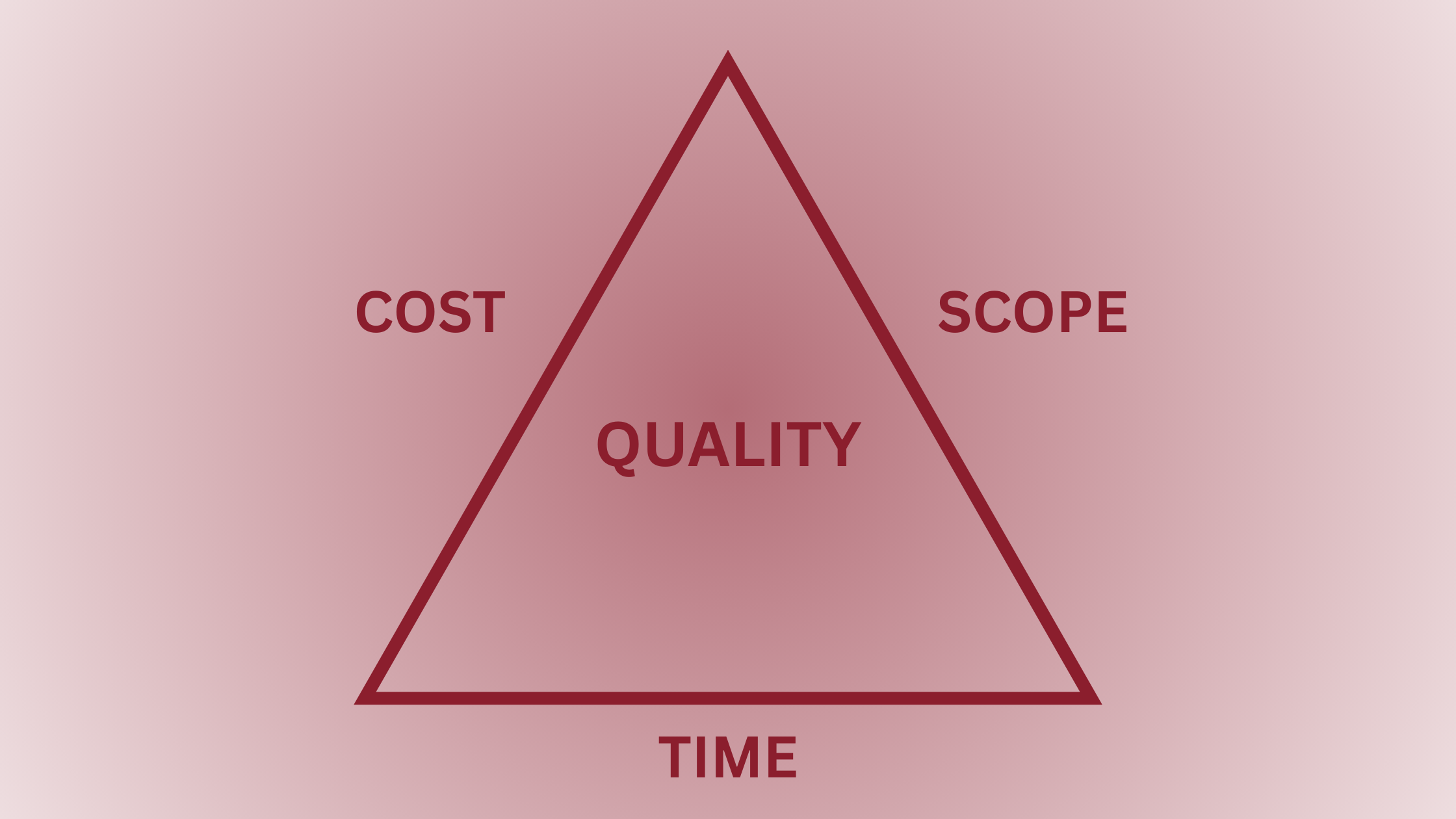
The Project Management Triangle shows how scope, time, and cost trade off against each other while quality sits in the middle, influenced by all three.
If you increase scope, you need more time, a higher cost, or both to maintain the same level of quality. If you shorten the timeline, quality is preserved only by increasing cost or reducing scope. There is no configuration where all three remain fixed without trade-offs.
Let’s look at each element more closely as it relates to HRIS implementations.
Scope
Scope is often the most straightforward place to start when understanding implementation cost. It typically includes:
- Modules being implemented
- Number of employees, locations, or legal entities
- Amount and complexity of data conversion
- Integrations with other systems
What is often overlooked is that size is not the same as complexity.
A large, mostly salaried organization operating in a single geography with standardized policies can be significantly less complex than a smaller organization operating across multiple regions with hourly employees, union or CBAs, and varying local rules.
Even smaller organizations require a baseline level of effort. Large-scale HRIS platforms carry inherent complexity regardless of headcount.
Scope also tends to evolve over the life of a project. New requirements, policy decisions, or deferred functionality often surface once design begins. Individually, these changes may feel small, but collectively, they impact both timeline and cost.
Time
Time is measured in billable hours.
If you have not worked on a project that is billed by the hour before, it can be helpful to understand what those hours represent. Billable hours are not limited to time spent on live calls with customers. They include any productive work required to move the project forward.
That work typically includes:
- solution and process design, configuration, and testing
- internal project alignment, including sales-to-delivery transitions and status reviews
- troubleshooting issues and adjusting configurations as requirements evolve
- research and validation of data, integrations, and edge cases
A lot of the most critical work, that essential to delivering a stable and effective implementation, happens when no one is in a meeting
Two main factors influence the total number of billable hours.
The first is timeline. While there is a minimum amount of time required to implement a system correctly, timelines often flex based on change management needs, busy seasons, phased rollouts, pilot groups, or multi-country strategies. Longer timelines reduce efficiency and increase total hours, which increases cost.
The second is effort driven by scope and complexity. Complexity shows up in policies, employee groups, pay rules, union or bargaining unit agreements, and configuration variations required to support how the organization actually operates.
More variation means more configuration, more testing, and more validation. That effort translates directly into additional time.
Cost
Price reflects the people doing the work.
In project-based delivery, cost is driven primarily by the level of expertise required to handle the scope and complexity of the implementation. More complex projects benefit from more experienced consultants who can anticipate issues, make sound design decisions, and reduce rework. Their rates reflect the experience required to make the right decisions early, when mistakes are most expensive.
Services organizations are paid for time and expertise. Unlike software vendors, they do not have alternative revenue streams to offset delivery costs. The value they provide is embedded in the quality of the work and the outcomes achieved.
Investing in the right expertise up front often reduces total cost and improves long-term value.
In Summary
Implementation costs make sense when you recognize that implementation is the work itself. Understanding how scope, time, and cost interact helps leaders plan more realistic budgets, avoid surprise expense, and reduce long-term regret.
- Pricing is shaped by trade-offs between scope, time, and cost
- Complexity is driven by how an organization actually operates, not just by its size
- Billable hours reflect the full range of effort required to deliver a stable, usable system
The real question is not why implementation costs what it does... it's what it costs the business when implementation is underfunded or rushed.
Miranda
Works at the intersection of sales and services & writes about implementation and life.
Learn More